
FuseIQ Platform
The operating system for enterprise AI.
FuseIQ is a single system of record for AI inside a company: what is prioritized, who owns it, who is using it, what is in production, how it is governed, and what value it produced. It is operated with PraxisIQ specialists through the FuseIQ Program.
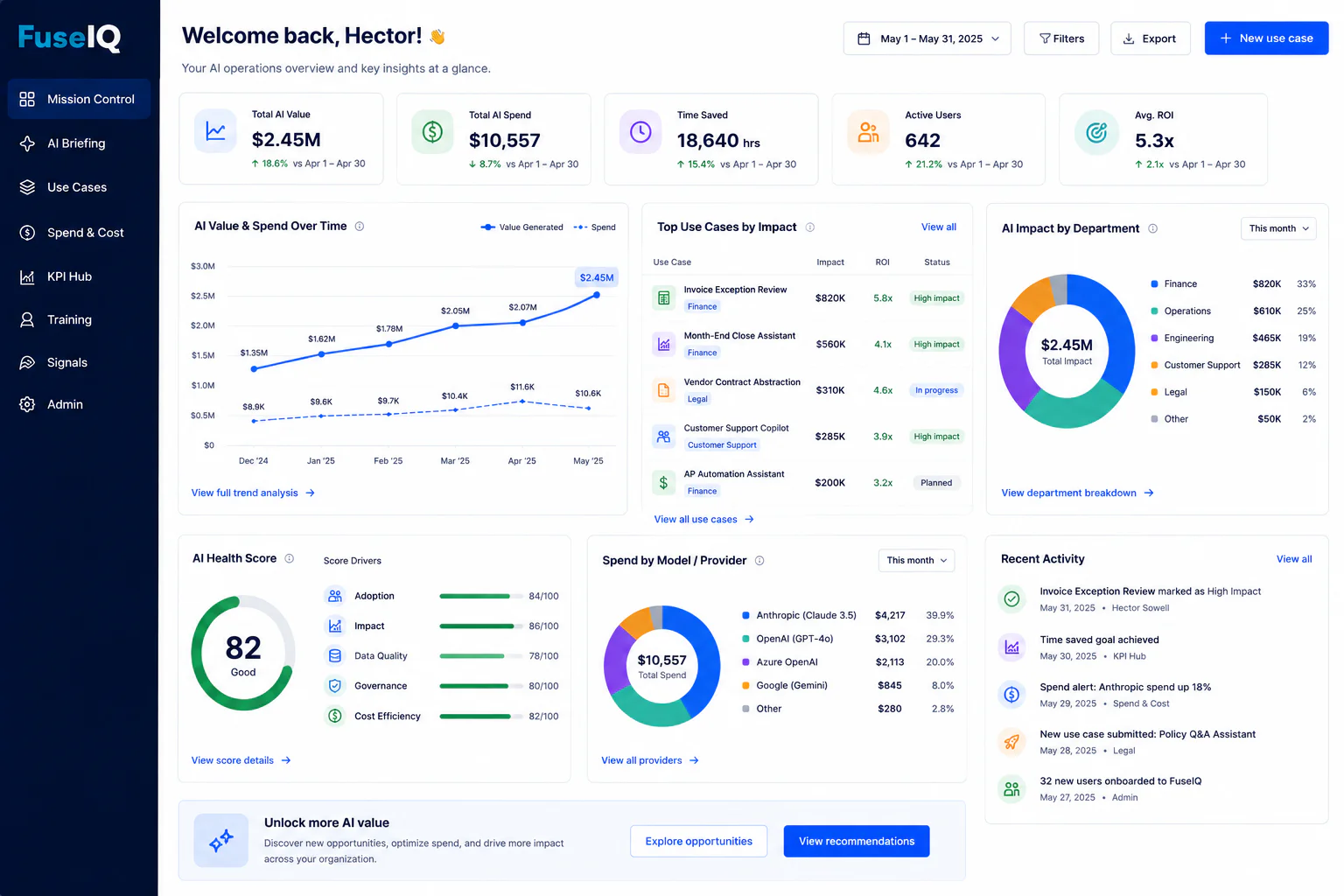
A system of record for AI, not another assistant.
Most AI tooling adds capability. FuseIQ adds control: it is the place where AI priorities, owners, adoption, delivery status, approvals, and value evidence are held together for the whole organization.
FuseIQ is built for organizations that already have AI activity and cannot yet answer basic operating questions about it. It sits above individual copilots, vendors, and pilots, and connects to the FuseIQ Program so the record is maintained by people accountable for outcomes.
- Who it is for
- Executive teams at mid-market software and technology-enabled companies, their functional leaders, and the sponsors and operating partners who back them.
- Who operates it
- Business and technology owners inside the company, supported by PraxisIQ forward-deployed specialists.
- What it replaces
- Scattered decks, tracker spreadsheets, disconnected training records, vendor dashboards, and consulting readouts that expire.
- What it produces
- A ranked portfolio, named owners, adoption signal, an approval trail, and a value method agreed with finance.
AI activity without an operating record.
- 01
Nobody can name the top five AI initiatives
Priorities live in separate functions and change with whoever presented last. Sequencing decisions are made without a shared view of value, feasibility, or capacity. - 02
Licenses are bought, workflows are unchanged
Seat counts rise while the underlying process stays manual. Usage telemetry from a vendor is not the same as adoption inside a workflow. - 03
Pilots have no owner after the demo
A successful proof of concept stalls because no one owns integration, evaluation, approval, or support once the enthusiasm passes. - 04
Governance arrives after the incident
Risk, approval, and quality controls get retrofitted, which is slower and more expensive than defining them as work enters the portfolio. - 05
Value is asserted, not evidenced
Without a measurement method agreed with finance up front, reported AI value is not comparable across functions or defensible to a board.
From company context to executive roll-up.
Each part of the product writes to the same record — so the context captured at onboarding is the same object being discovered, prioritized, governed, deployed, adopted, costed, and measured later.
01
Company and AI context
The record starts with how the business actually runs.
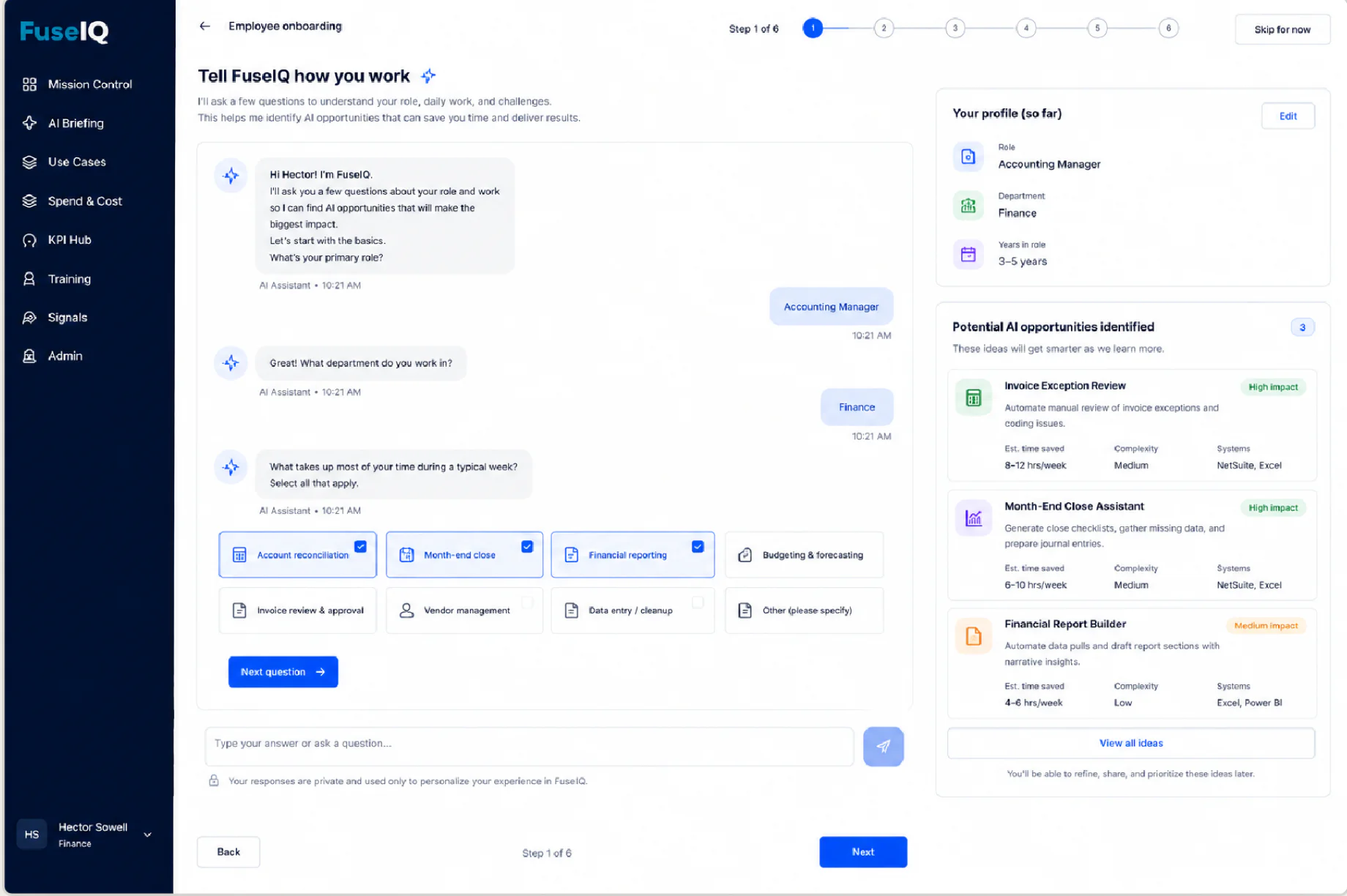
Onboarding captures departments, people, systems, goals, KPIs, AI platforms, licenses, and spend. Everything downstream is scored against that baseline rather than against a generic maturity model.
02
Use-case discovery
Opportunities come from the people doing the work.
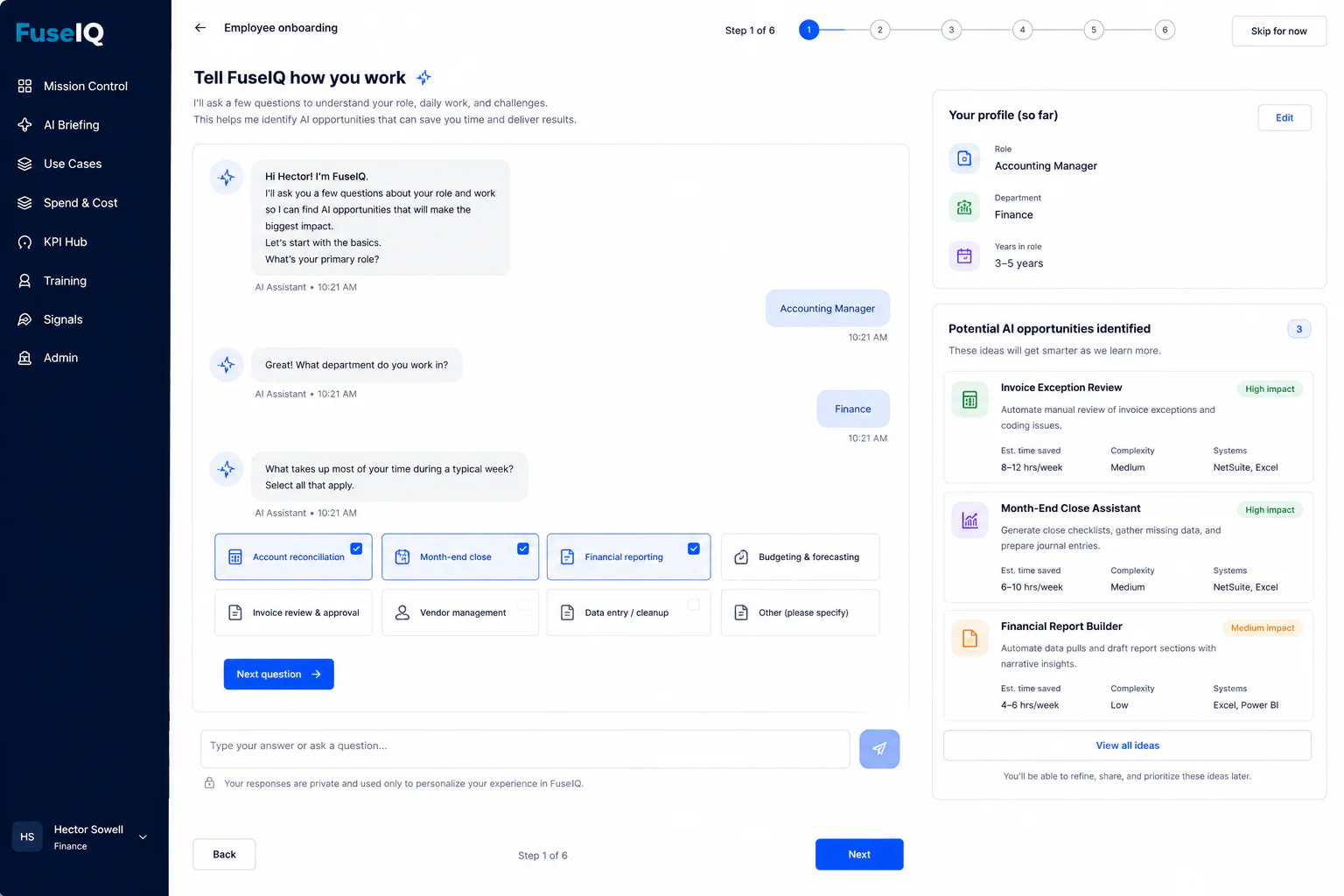
Guided discovery conversations capture daily work, repetitive effort, and operational bottlenecks role by role, and turn them into candidate use cases attached to a real workflow.
03
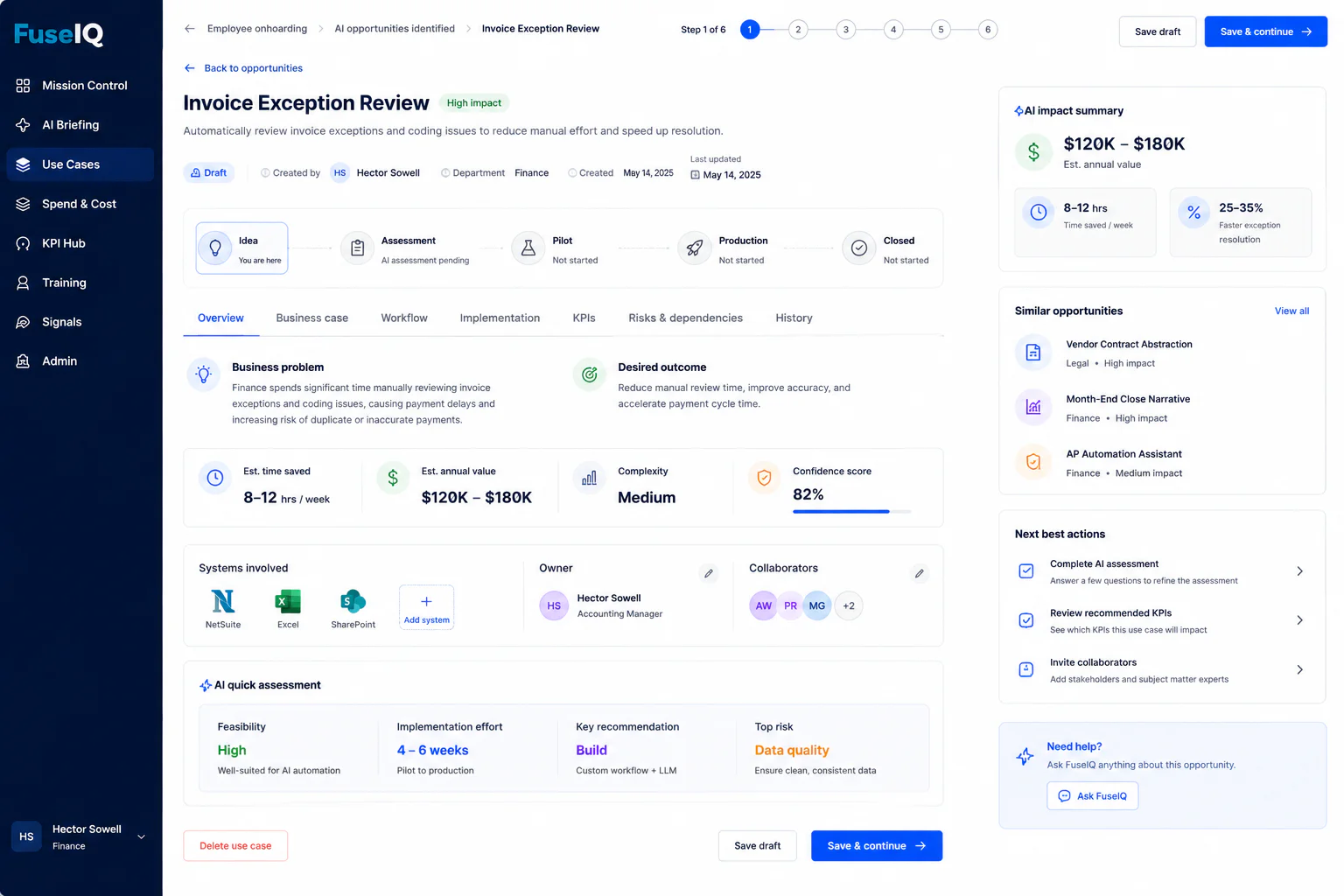
Prioritization and business cases
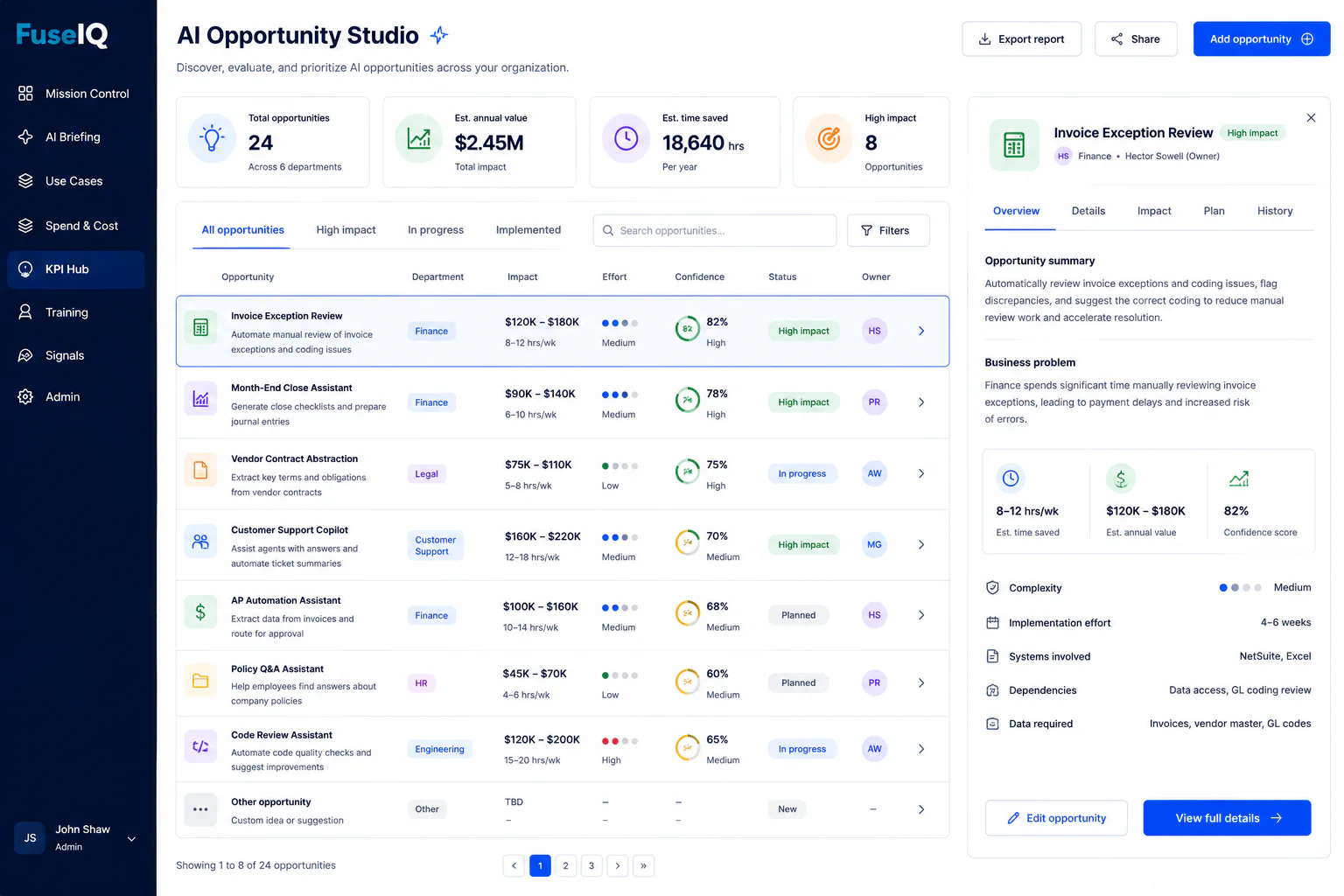
One ranked portfolio, each entry with a business case.
Candidates are evaluated on value, feasibility, data readiness, risk, ownership, and build-versus-buy. Each entry carries an estimated impact, effort, and confidence the executive team can challenge.
04
Governance and approvals
Controls are set before a workflow reaches production.
Approvals, human-in-the-loop checkpoints, evaluation results, and risk exceptions are recorded on the use case itself, so a reviewer can reconstruct what was approved and by whom.
05
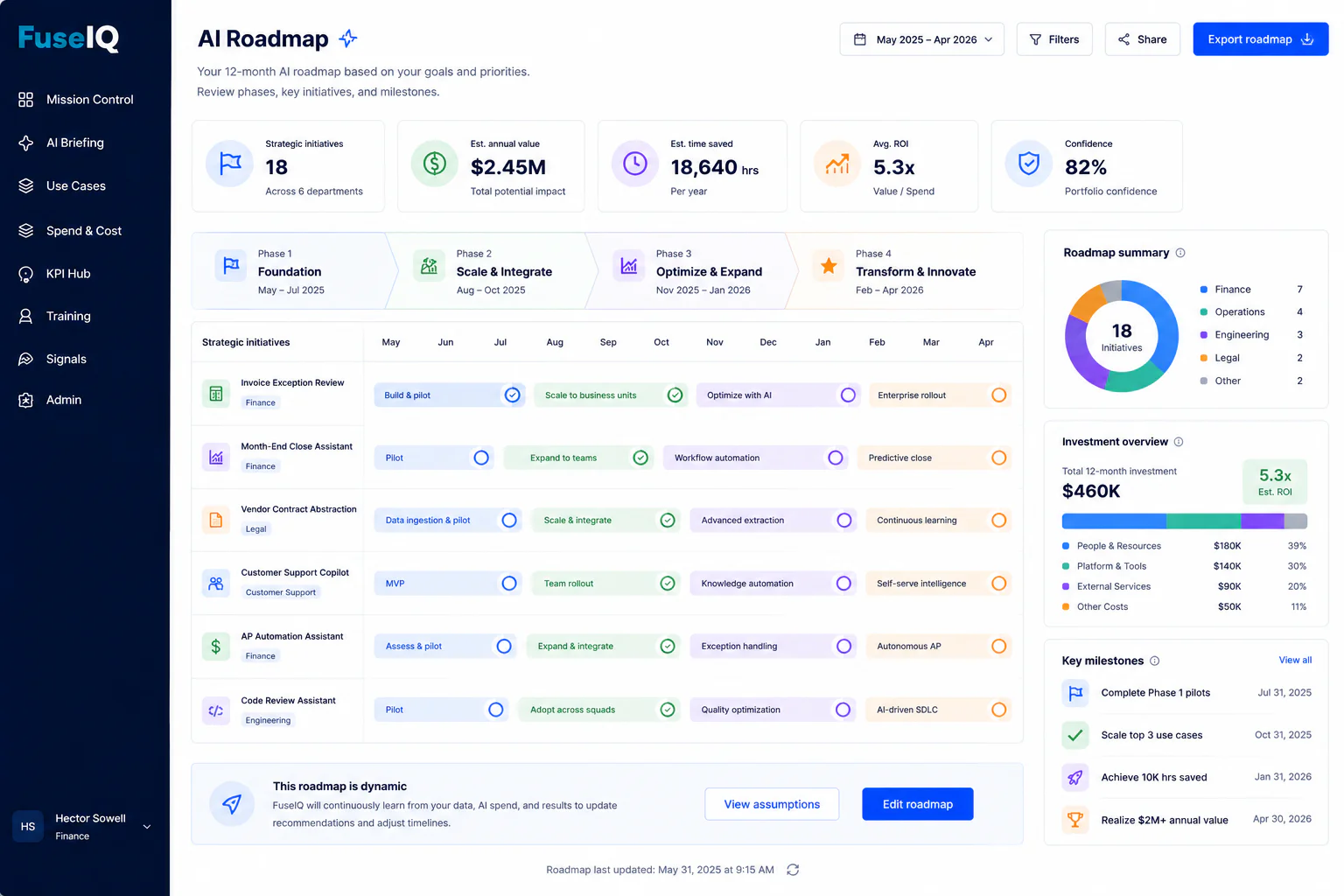
Deployment and ownership
Sequenced delivery with a named owner per initiative.
The roadmap holds phases, dependencies, and investment against the same records that were prioritized. Delivery status and ownership stay visible instead of living in a project tracker.
06
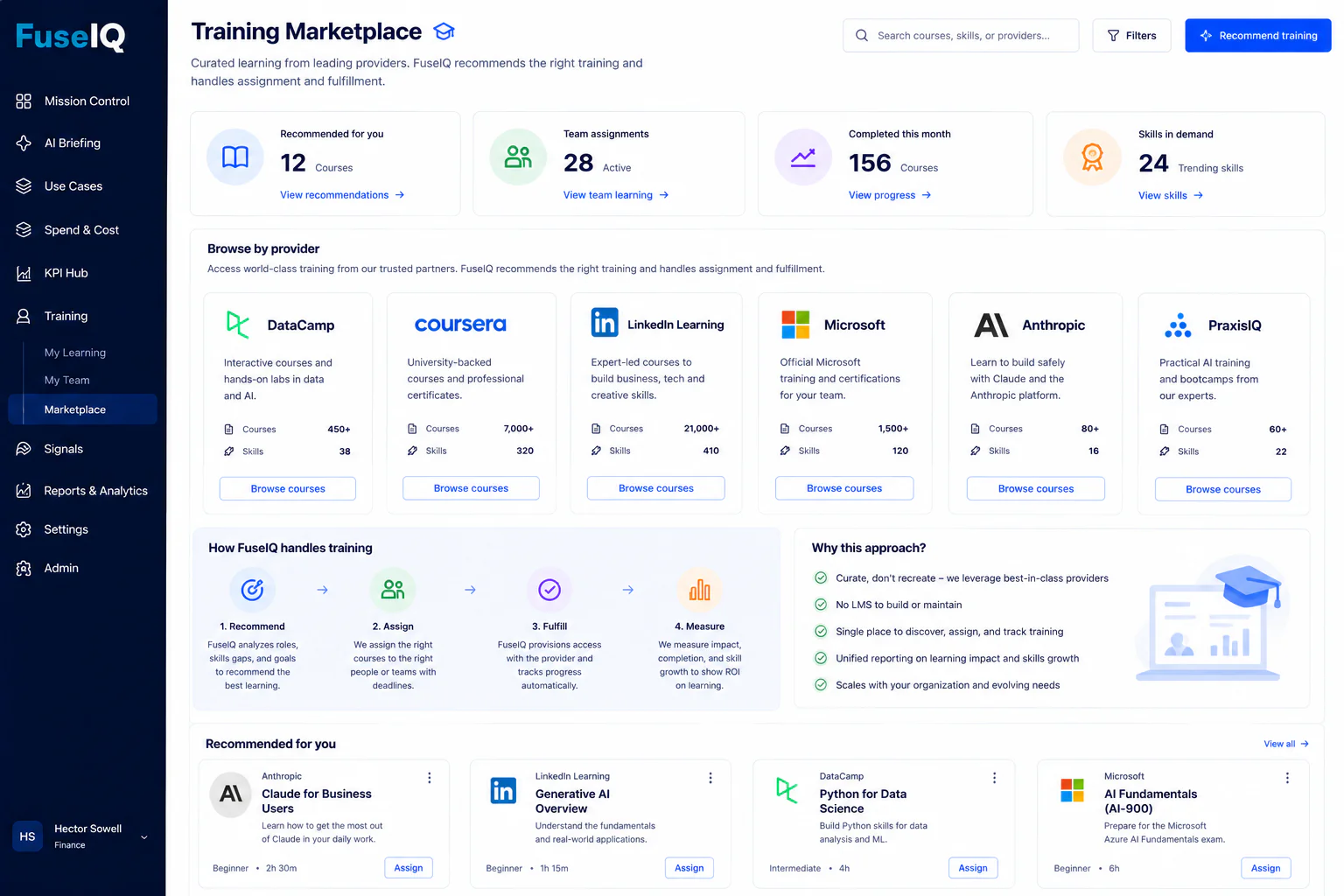
Workforce adoption
Enablement attached to the use cases each team owns.
Role-based training is recommended and assigned against the work a function is accountable for, and participation becomes an observed adoption signal rather than an attendance list.
07
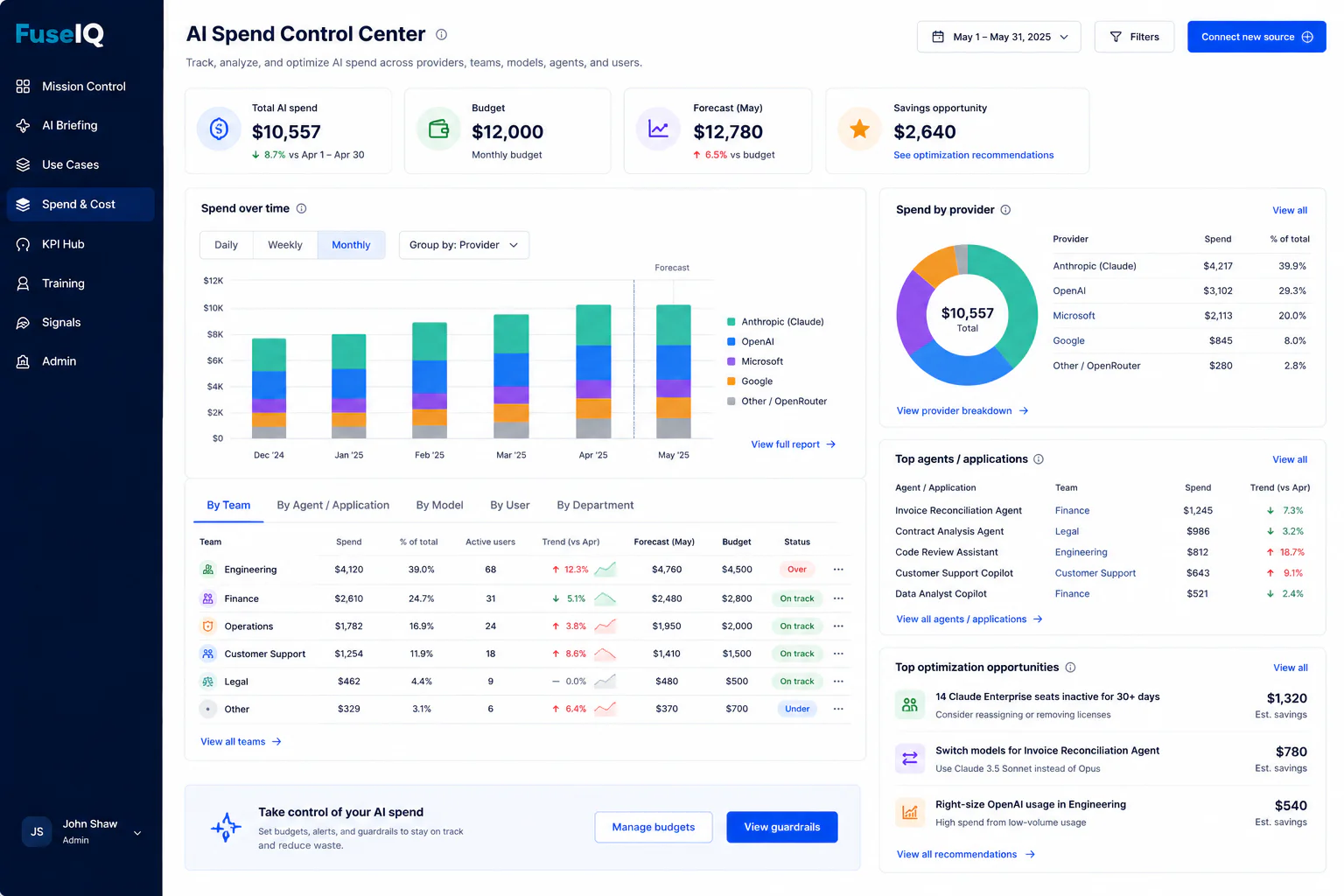
AI spend and optimization
AI cost is tracked, forecast, and optimized.
Spend is broken out by provider, team, agent, and model against budget, with optimization opportunities surfaced alongside the saving each one represents.
08
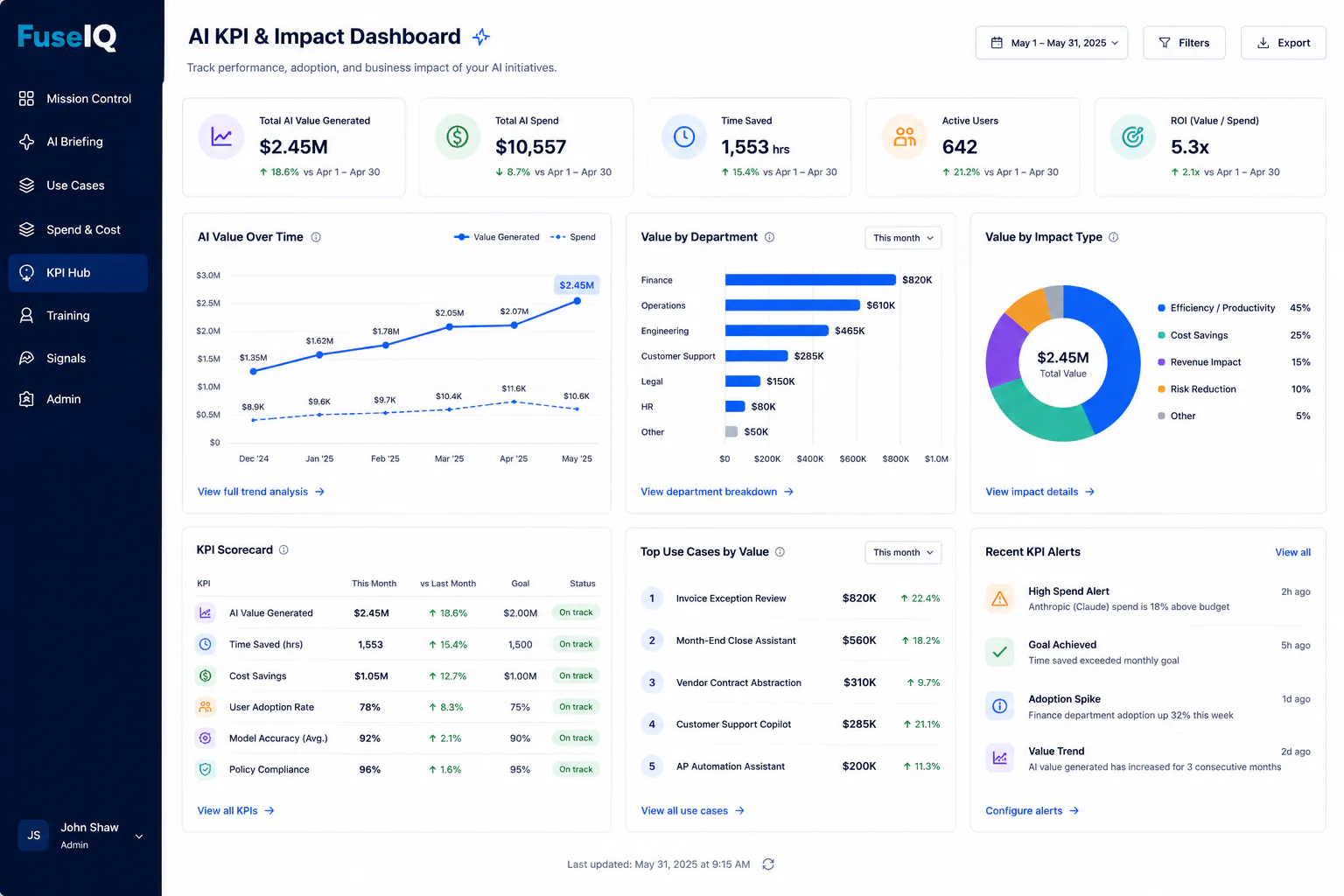
KPI and value measurement
Each initiative is connected to KPIs agreed with finance.
Adoption, operational, financial, and quality KPIs sit against the initiative that produced them, and results are reconciled to source data before they are reported.
09
Department workspaces
Each function works its own portfolio.
Finance, engineering, field, commercial, and support see the use cases, owners, adoption, and outcomes that belong to them, writing to the same record leadership reads.
10
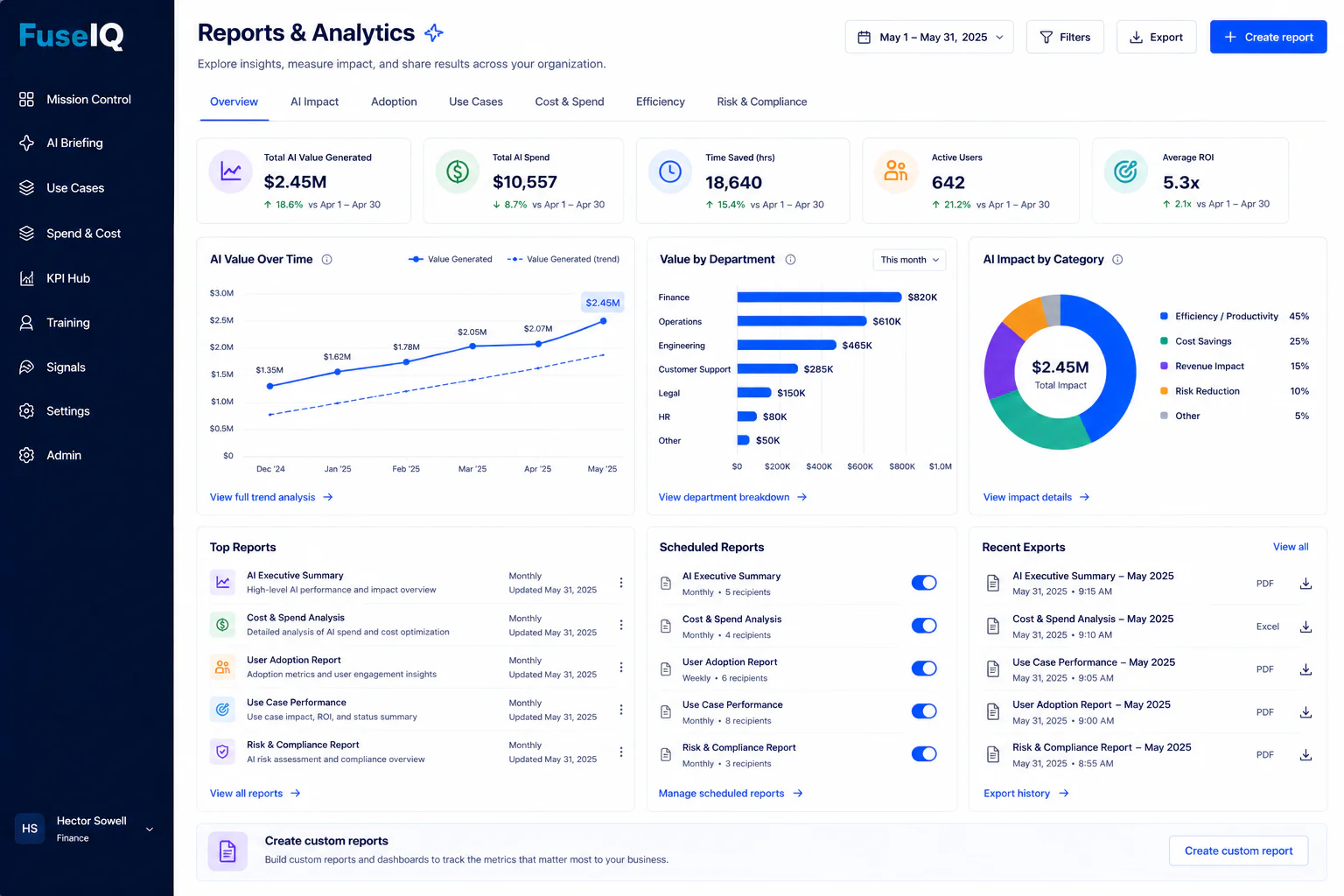
Executive roll-up
One set of numbers for the leadership conversation.
Impact, adoption, use-case status, cost, and risk roll up across departments into reporting the executive team and board can use without a reconciliation exercise first.
Principles the platform is built on.
FuseIQ is deployed into environments where finance, field, and engineering data already have controls. The platform is designed to respect them rather than route around them.
- Human approval is retained
- Workflows that change financial or contractual state keep a human approval step. Automation prepares the decision; a person makes it.
- Auditability by default
- Approvals, exceptions, ownership changes, and workflow revisions are recorded so a reviewer can reconstruct what happened and who signed off.
- Least-privilege integration
- Connections to systems of record are scoped to the data a workflow needs, and access is reviewed with the customer's own security process.
- Evaluation before production
- Agents and workflows are evaluated against representative cases before they run against live operations, and re-evaluated after material change.
- Customer ownership of data
- Customer operational data belongs to the customer. FuseIQ holds the operating record; it is not a repackaging of your source systems.
- Model-neutral
- Model and vendor choices are made per use case against evaluation results, and can change without rebuilding the operating record around them.
What is software, and what is program work.
A precise line matters here. Some of what customers experience today is delivered by PraxisIQ specialists inside the program, with FuseIQ as the record. Where that is true, we say so.
In the platform today
- The use-case portfolio, scoring inputs, ownership, and stage tracking.
- Enablement tracks, participation, and adoption signal by role.
- Workflow and agent delivery status with evaluation and approval records.
- Governance record: approvals, risk exceptions, and change history.
- The agreed value method and the evidence attached to each initiative.
Delivered through the program
- Maturity assessment, opportunity sizing, and executive alignment sessions.
- Workflow discovery with the people who do the work today.
- Forward-deployed engineering to build and integrate production workflows.
- Evaluation design and the review cadence around live workflows.
- Value verification with finance before results are reported.
See how this is structured in the FuseIQ Program.
Use cases that run inside the record.
- Finance operations
- Invoice and PO/WO reconciliation, exception review, and budget checks with human approval on financial change.
- Engineering delivery
- Agentic planning, review, and remediation practices tracked against quality and adoption evidence.
- Contract and commercial
- Contract intelligence and obligation review routed to the owner responsible for the commitment.
- Field and service
- Work-order intelligence and operational review where field knowledge is required to resolve exceptions.
- Support
- Deflection and assist workflows measured on resolution quality, not deflection volume alone.
- Portfolio oversight
- Comparable maturity, adoption, and value signals across companies for sponsors and operating partners.
FuseIQ
See the operating record against your own priorities.
A working session with a PraxisIQ lead: the four pillars in the product, the program that keeps them current, and how value would be measured in your business.