
Solutions — Enterprise Agents
Agents with scoped authority and a name on the approval.
An agent that touches financial or contractual state is an operating system component, not a demo. PraxisIQ builds agents with explicit authority boundaries, evaluated behaviour, and a governance record in FuseIQ.
Authority: read, prepare, propose
Human approval on financial change
Evaluation cases passing
Escalation path defined
Change history retained
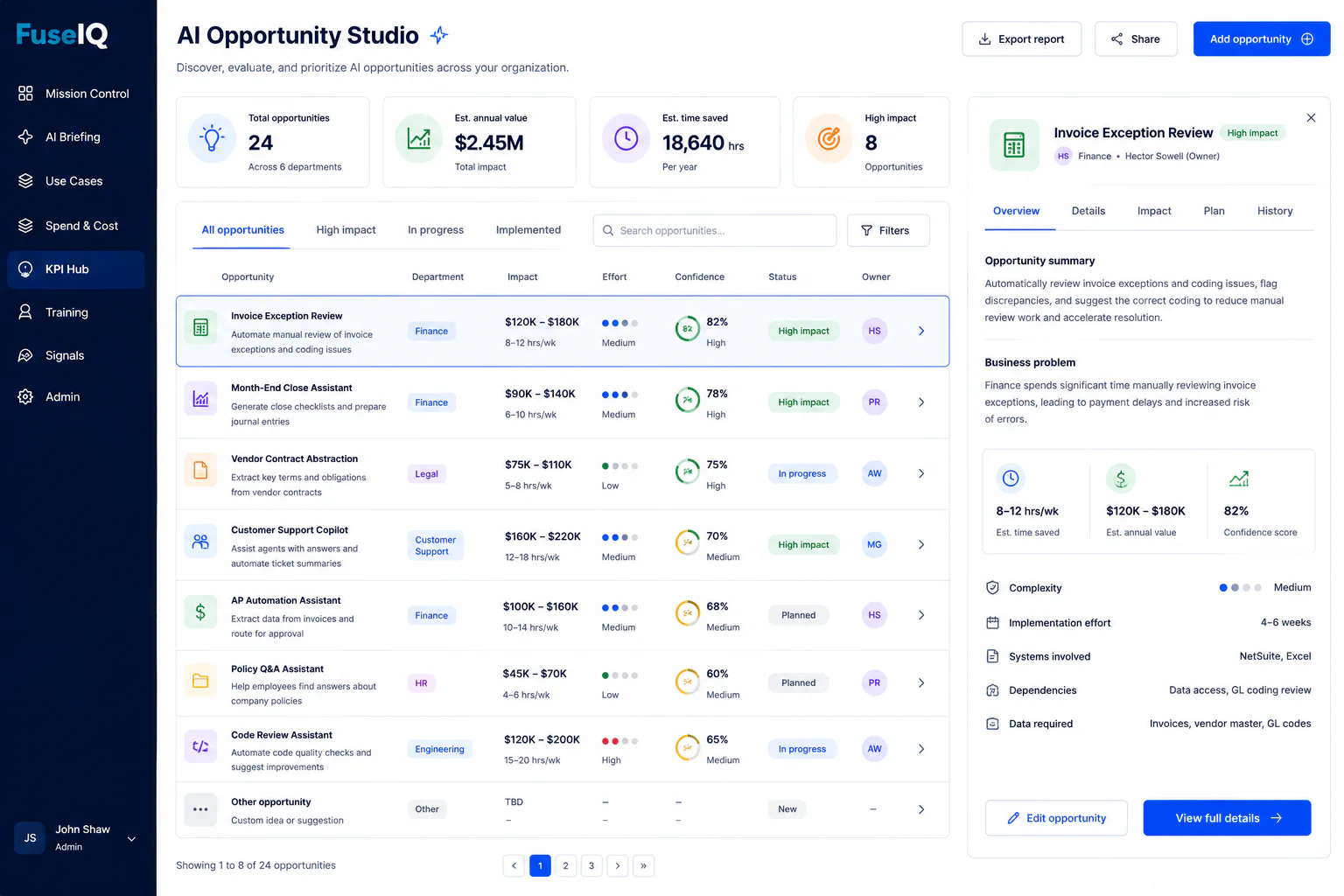
Opportunity and delivery pipelineFuseIQ product interface
01Design principles
Autonomy is granted, not assumed.
The useful question is not how autonomous an agent can be, but what authority the business is willing to delegate and under what evidence.
- 01
Scope authority explicitly
Every agent has a written boundary: what it can read, what it can prepare, what it can change, and what always requires a person. - 02
Prepare the decision, keep the approver
For financial and contractual work, the agent assembles evidence and a recommendation; a named human commits the change. - 03
Evaluate against representative cases
Behaviour is measured against real historical cases before production and re-measured after any material change. - 04
Design the exception path first
Most operational value is in exceptions. If the escalation route is unclear, people abandon the agent at the first hard case.
02Patterns
Where agents earn their place.
- Reconciliation and matching
- High-volume comparison across systems where exceptions, not matches, need human attention. See the Salt Creek work.
- Document and obligation review
- Extraction and comparison against policy, routed to the owner accountable for the commitment.
- Operational triage
- Classifying, enriching, and routing incoming work so specialists spend time on judgement rather than sorting.
- Engineering assistance
- Planning, review, and remediation practices measured on delivered quality rather than suggestion volume.
03Governance
What a reviewer can reconstruct.
Governance is recorded in the same place as delivery, described on the platform page.
- Who approved
- The named person who committed each change of state.
- On what evidence
- The inputs, comparison, and recommendation presented at approval.
- Under which version
- The workflow and evaluation version in force at the time.
- With what exceptions
- Open and resolved risk exceptions attached to the agent.
FuseIQ
Scope an agent against a real queue.
Bring a workflow with volume and exceptions; we will define the authority boundary, evaluation approach, and approval path.